
What is a Landing Page and Why Does It Matter?
A landing page is a standalone web page built with one specific goal: getting visitors to take a single action.
Unlike a homepage, which offers multiple menus and navigation paths, this type of page stays laser-focused on one objective, whether that’s collecting leads, promoting a product, or driving a sale.
There are no distractions here. No extra links, no competing messages. Just one clear path for the visitor to follow.
Whether you’re running Google Ads, social media campaigns, or email marketing, sending traffic to this kind of dedicated page can significantly boost your conversion rate.
Why? Because focus works. When visitors aren’t pulled in different directions, they’re far more likely to complete the action you want: sign up, buy, download, or subscribe.
In short, general web pages inform, but this kind of page converts.
Why Does a Landing Page Matter?
A landing page is important because it helps convert visitors into customers by providing a clear and distraction-free experience. Instead of overwhelming users with multiple choices, it guides them toward one action.
Here are some key benefits:
- Higher Conversion Rates: Focused messaging increases the chances of users taking action.
- Better Lead Generation: Capture emails, phone numbers, or inquiries more effectively.
- Improved Ad Performance: Matching your ad with a relevant landing page improves user experience and campaign results.
- Clear Call-to-Action (CTA): Encourages visitors to sign up, buy, download, or contact you.
- Easy Performance Tracking: Measure conversions and optimise campaigns using analytics.
Basic Structure of a High-Converting Landing Page
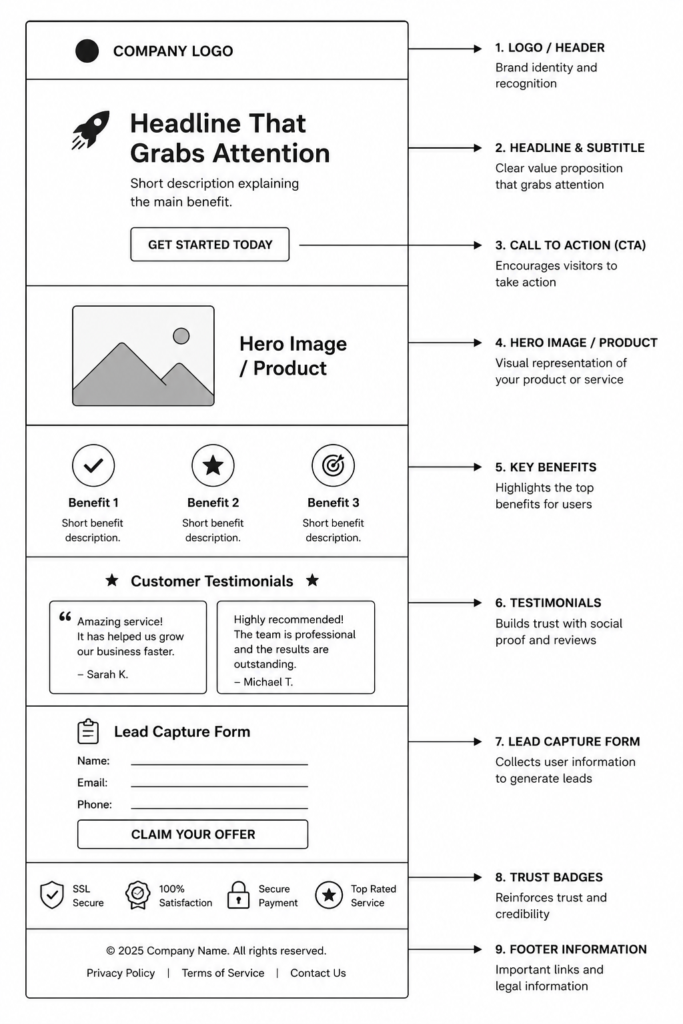
Key Elements of an Effective Landing Page
Attention-grabbing headline — The first thing visitors see; must instantly communicate what you offer and hook interest.
Clear value proposition — A concise statement of why someone should choose you, what makes you different, and what they gain.
Engaging visuals — Relevant images, videos, or graphics that support the message and build trust, not just decoration.
Benefits-focused content — Emphasises what the user gets (outcomes) rather than just listing features.
Social proof — Reviews, testimonials, ratings, or client logos that build credibility and reduce hesitation.
Strong CTA — A clear, action-oriented button or prompt (“Get Started,” “Buy Now”) telling visitors exactly what to do next.
Simple lead form — Minimal fields (name, email) to reduce friction and increase conversion rates.
Mobile-friendly and fast-loading design — Ensures a smooth experience across devices, since slow or clunky pages drive people away.
Together, these elements guide a visitor smoothly from interest → trust → action.
Common Landing Page Mistakes to Avoid
1. Weak or Confusing Headline
If visitors don’t understand your offer within a few seconds, they’re likely to leave.
2. Too Many Call-to-Actions (CTAs)
Multiple buttons with different goals can confuse users. Focus on one clear action.
3. Slow Page Loading Speed
A slow landing page increases bounce rates and reduces conversions.
4. Cluttered Design
Too much text, excessive images, or unnecessary elements distract visitors from your main message.
5. Poor Mobile Optimisation
Most users browse on mobile devices. A non-responsive landing page can cost you conversions.
6. Long or Complicated Forms
Request only the information you actually need. Shorter forms generally perform better.
7. No Trust Signals
Without testimonials, reviews, certifications, or security badges, visitors may hesitate to take action.
8. Unclear Value Proposition
Visitors should immediately understand what they’re getting and why it’s valuable.
9. Ignoring SEO Basics
Missing keywords, meta descriptions, and proper headings can reduce your landing page’s visibility in search engines.
10. Not Testing and Optimizing
Failing to run A/B tests or analyse user behavior means missing opportunities to improve conversions.
A successful landing page follows one simple formula:
Clear Headline → Strong Value Proposition → Social Proof → Simple Form → Powerful CTA → Fast Loading → Mobile-Friendly Design
What is the main purpose of a landing page?
The primary purpose is to encourage visitors to complete a specific action, such as filling out a form, making a purchase, or booking a consultation.
How is a landing page different from a homepage?
A homepage provides general information and multiple navigation options, while a landing page focuses on one campaign and one clear call-to-action.
Can a landing page improve conversion rates?
Yes. Because it removes distractions and delivers targeted messaging, a well-designed landing page typically converts better than a standard website page.
Read More at Origin8Marketing
